GENERATIONAL WEALTH
For centuries the wealthiest families have used the same legal mechanism to keep what they built. It is called a trust. We bring it to your family.
"The difference between wealthy families and formerly wealthy families starts with one thing. A properly structured trust."
Sean F Godson, Co-Founder
WHERE TRUSTS COME FROM
Trusts were invented in medieval England. When knights left for the Crusades, they transferred ownership of their lands to a trusted friend or steward. The arrangement was simple. Hold this for my family while I am gone. Manage it. Protect it. Return it when I come back, or pass it on if I do not.
Some of those friends did not return the lands. The original families had no legal recourse. Common law did not recognise the arrangement — the friend was the legal owner.
So the Court of Chancery stepped in. The Lord Chancellor, acting on the King's behalf, ruled that even though the friend held the legal title, they were bound to use the land for the benefit of the original family. The friend's promise — the relational trust — was given the force of law.
That was the birth of the Trust as we know it. Eight hundred years later, the framework is still the same.
The legal kind of trust was invented to protect the relational kind when it broke down. That is the foundation of everything we do.
WHAT A TRUST IS
In plain English, three roles.
The Settlor — that is you. The person who sets up the Trust and decides what goes into it.
The Trustees — the people, or professional firm, you choose to look after the assets. They make decisions about the Trust on behalf of those who benefit from it.
The Beneficiaries — the people you love. The ones who receive the use, the income, or the assets themselves, according to the terms you set.
The Trust holds the assets. The Trustees act for the Beneficiaries. You decide all of it.
Once assets are in the Trust, they are no longer part of your personal estate. That is the structural point.
THEY'RE EVERYWHERE
Trusts are not exotic. They are the quiet structural choice behind some of the most enduring institutions in the country.
THE POWER OF A TRUST
Drag the slider to see the difference.
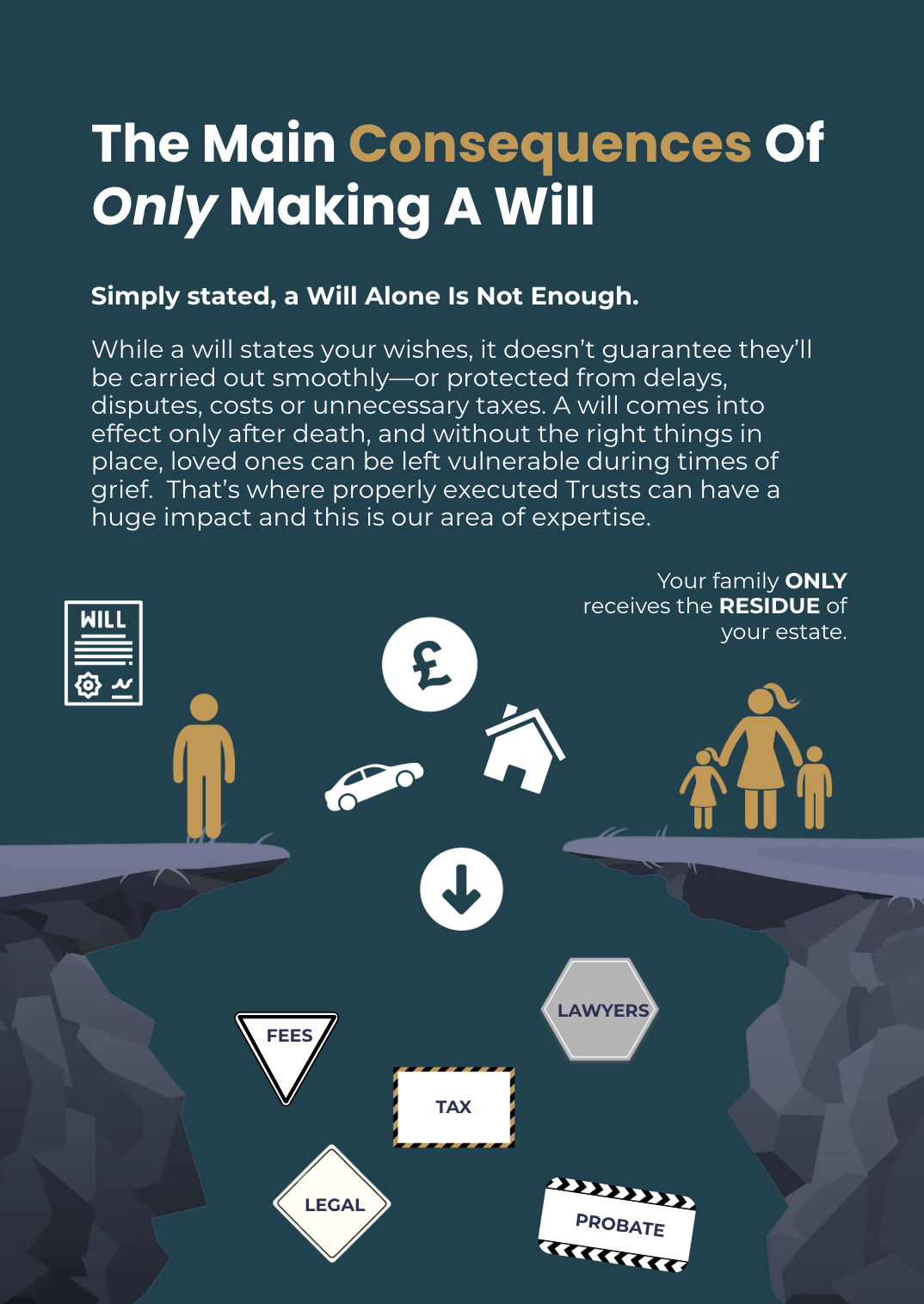
Without a Trust, what you leave behind has to cross a chasm. Probate. Legal fees. Inheritance Tax. Disputes. Delays. By the time it reaches your family, much of what you built has been consumed along the way. Your family receives only the residue.
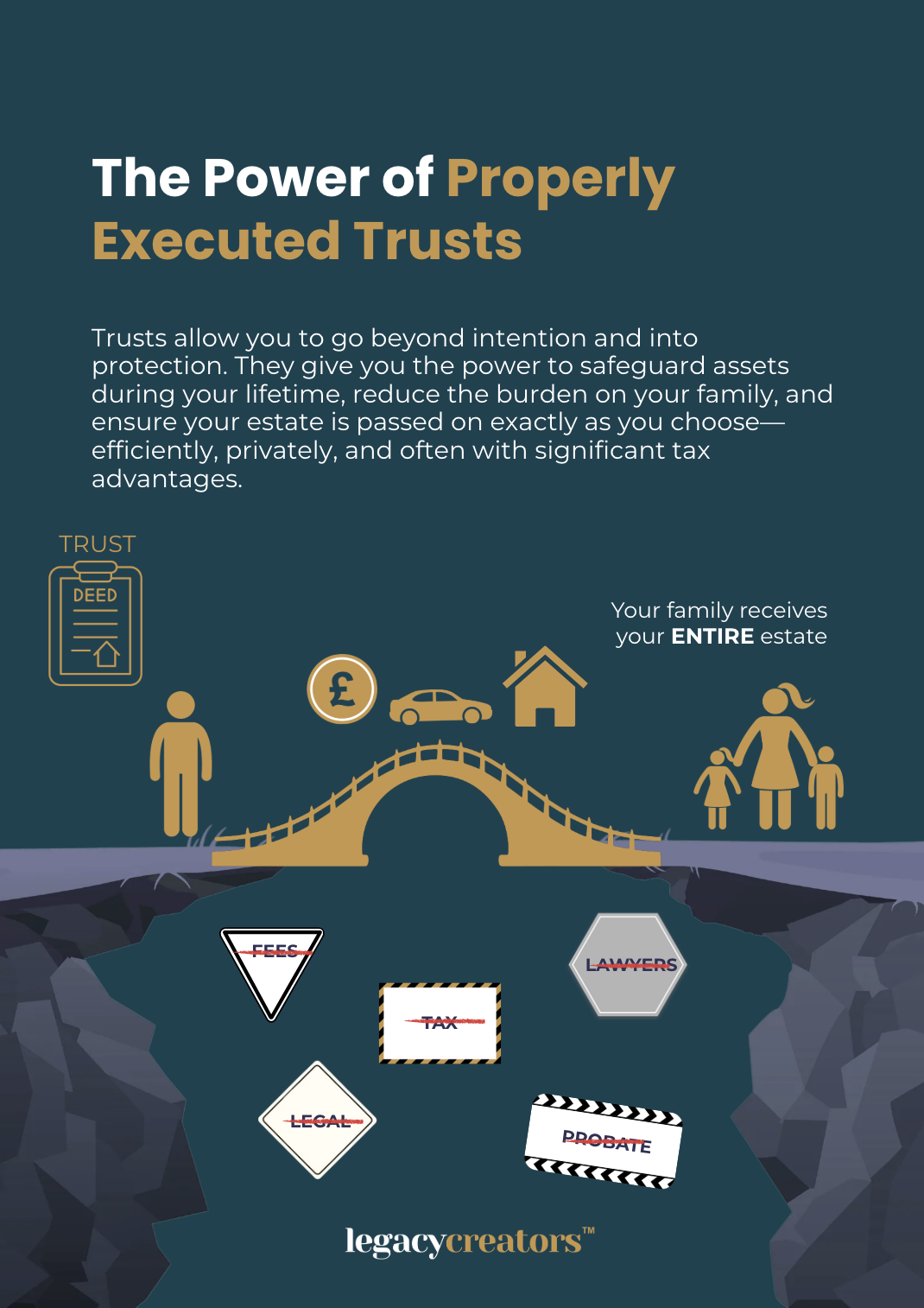
With a properly executed Trust, what you leave behind crosses on a bridge. Your family receives the entire estate. Efficiently. Privately. Exactly as you intended.
That is the difference between a Will alone and a Will properly paired with a Trust.
WHICH TRUST IS RIGHT FOR YOU?
A Bare Trust. A Discretionary Trust. A Life Interest Trust. A Children's Trust. A Disabled Discretionary Trust. A Pension Bypass Trust. A Life Insurance Trust. A Nil Rate Band Trust. A Business Property Relief Trust.
Every Trust has different rules, different tax treatment, and different purposes. The right Trust for your family depends entirely on what you are trying to protect, who you are trying to protect, and what is sitting in your estate today.
This is not a one-size-fits-all decision. And it is not a decision you should be expected to make on your own.
Here is how we help:
You do not need to know which Trust you need. You need to know that you can.
YOUR FAMILY. YOUR LEGACY.
The Free Review takes a few minutes of your time.
020 3376 7910 — Monday to Friday, 9am to 6pm